Monday, May 13, 2013
Friday: Graduating Students to Read at Urban Arts Festival
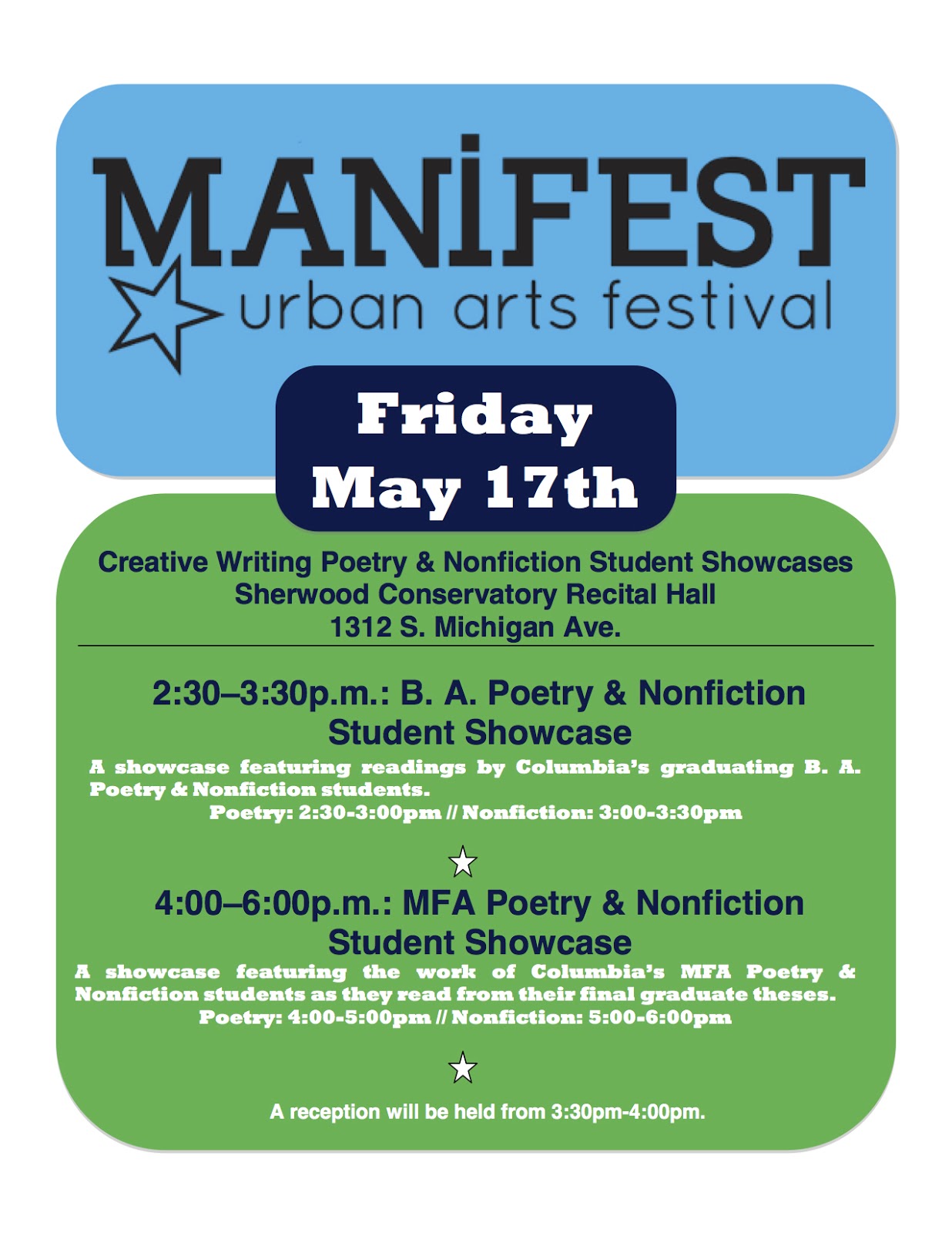
This Friday, May 17, as part of Columbia College's annual Manifest Urban Arts Festival, graduating students will showcase their work. Along with B.A. Poetry & Nonfiction showcases and an MFA Poetry showcase, the inaugural class of Columbia's MFA in Nonfiction Program will read from their graduate theses as part of the festival.
Readings will take place at the Sherwood Conservatory Recital Hall, 1212 S. Michigan Ave., from 2:00 p.m. to 6:00 p.m.
Tuesday, April 23, 2013
Maddison Hamil to Read at 33
MADDISON HAMIL is an MFA Candidate in the Nonfiction Program at Columbia College Chicago, where she also teaches first year writing, works in the Fashion Department and serves as an editor for Hotel Amerika. She loves a good list and romance novels are a guilty pleasure.
Monday, April 15, 2013
April 16: Amy Leach & Dinty Moore
A forthcoming reading, sponsored by Columbia College Chicago's programs in Nonfiction:
AMY LEACH is the author of Things That Are, published by Milkweed Editions. She holds an MFA in creative nonfiction from the University of Iowa, and her work has appeared in Best American Essays, A Public Space, Orion, and The Gettysburg Review, among other journals. She has been recognized with the Whiting Writers' Award and a Rona Jaffe Foundation Award. She lives in Montana.
DINTY W. MOORE is author of The Mindful Writer: Noble Truths of the Writing Life, as well as the memoir Between Panic & Desire, winner of the Grub Street Nonfiction Book Prize in 2009. He also edited The Rose Metal Press Field Guide to Writing Flash Nonfiction: Advice and Essential Exercises from Respected Writers, Editors, and Teachers. Moore has published essays and stories in The Southern Review, The Georgia Review, Harpers, The New York Times Sunday Magazine, The Philadelphia Inquirer Magazine, Iron Horse Literary Review, and Crazyhorse, among numerous other venues. A professor of nonfiction writing at Ohio University, Moore has won many awards for his writing, including a National Endowment for the Arts Fellowship in Fiction. He edits Brevity, an online journal of flash nonfiction, and lives in Athens, Ohio, where he grows heirloom tomatoes and edible dandelions.
![]() |
| Photo by Lynn Duggan |
![]() |
| Photo by Renita Romasco |
Tuesday, March 12, 2013
Mark Augustine & Emily Schikora at the 33 Reading Series
MARK AUGUSTINE is an MFA Candidate in the Nonfiction Program at Columbia College Chicago. He was prom king in high school.
EMILY SCHIKORA is an MFA Candidate in Nonfiction at Columbia College, where she is also a Graduate Student Instructor. She has a chapbook, "I Thought I Was Your Favorite," by Habit Books. From Fairbanks, Alaska, Emily currently divides her time between Portland, Oregon, and Chicago.
Thursday, February 21, 2013
Caitlynn Martinez-McWhorter, Dauren Velez to Read at 33 Reading Series
CAITLYNN MARTINEZ-MCWHORTER, a native of the Chicago suburbs, is currently an MFA Candidate in Nonfiction Writing at Columbia College Chicago where she teaches First-Year Writing. She can do a one handed pushup, has potty trained a wombat, and owns over 200 pairs of shoes.
DAUREN VELEZ is a Nonfiction Candidate at Columbia Chicago, with a background in the Liberal Arts from St. John's College in New Mexico. She is interested in using the essay form to explore the subject of time, which of course an incredibly straightforward and simple endeavor.
Wednesday, January 9, 2013
Colleen O'Connor at The Dollhouse #19
Join us as we watch the brilliant Colleen O'Connor read her work at The Dollhouse Reading Series this Saturday, January 12!
According to The Dollhouse's Tumblr, "Colleen’s essays can be jarring, urgent, and cutting, yet remain all the while sincere and incredibly personal. That’s something. And she does a mean karaoke." Go get 'em, Colleen!
Tuesday, January 8, 2013
Brett Slezak in The Doctor T.J. Eckleburg Review
Congratulations, Brett!
Monday, November 26, 2012
MFA Candidate Launches New Journal
First-year MFA Candidate Naomi Washer has launched the inaugural issue of Ghost Proposal, a new online journal of Poetry and Creative Nonfiction.
Though currently closed for submissions, Ghost Proposal wants "your word memories like bathing suits that don't fit," and "seeks to represent a wide range of brain activity and circuitry in poetry, creative nonfiction, and multimedia." Please click here to give Issue #1 a read. Congratulations, Naomi!
Thursday, October 4, 2012
Friday, May 11, 2012
Maddison Hamil Featured in Marginalia
Marginalia, Columbia's graduate student-centered blog (and featuring the writing of our own Jennifer Tatum-Cotamagaña) sets its sights this week on MFA Candidate Maddison Hamil. Click here to give it a read!
Friday, April 13, 2012
THE 33 READING SERIES: APRIL 19TH
WES JAMISON is an MFA Nonfiction candidate, Follett Fellow, and Graduate Student Instructor at Columbia College Chicago. His essays and poems have appeared or are forthcoming in 1913: a Journal of Forms, Columbia Poetry Review, and South Loop Review: Creative Nonfiction + Art. He appreciates three-sentence bios for their poetic roundness, but is reminded that he is writing his bio, not a poem.
SARA PECK hails from south of the Mason-Dixon where people make proper sweet tea and know what kind of food grits are. When not studying the poetics of the Black Mountain School, you can find Sara participating in one of her many worldly hobbies such as making vegan snacks, haunting the Rainbo Club, and appreciating a good mustache.
JENNIFER TATUM-COTAMAGAÑA's poems and essays are published and or forthcoming in 1913: a journal of forms, Columbia Poetry Review and South Loop Review's Creative Nonfiction + Art Online. From California, by way of Texas, she blogs, teaches, writes and makes breakfast for dinner. She is also in complete denial that Ryann Wahl is moving to New York City.
RYANN WAHL is a native of the Midwest and currently lives in Chicago, though tragically not for much longer. After completing her MFA from Columbia College Chicago, she will move to the Big Apple to pursue one of her many talents, which include but are not limited to: securing seating at busy bars, hosting excellent parties, and, of course, writing lovely poems.
Wednesday, April 11, 2012
Robin Hemley Reading 4/17
Columbia College Chicago Presents
a Creative Writing-Nonfiction Program Event
Sponsored by the Department of English in the School of Liberal Arts & Sciences:
A reading by ROBIN HEMLEY
Hokin Hall
623 S. Wabash Ave., Room 109
Tuesday, April 17, 5:30p.m.
The event is free and open to the public.

623 S. Wabash Ave., Room 109
Tuesday, April 17, 5:30p.m.
The event is free and open to the public.
Photo: Catherine Segurson
ROBIN HEMLEY is the author of eight books of nonfiction and fiction and the winner of many awards including a 2008 Guggenheim Fellowship, The Nelson Algren Award for Fiction from the Chicago Tribune, The Story Magazine Humor Prize, an Independent Press Book Award, two Pushcart Prizes and many others. His fiction, nonfiction, and poetry has been published in the U.S., Great Britain, Germany, Japan, the Philippines, Hong Kong, and elsewhere and he frequently teaches creative writing workshops around the world. He has been widely anthologized and has published his work in such places as The New York Times, Orion, The Wall Street Journal, Chicago Tribune, New York Magazine, and many of the finest literary magazines in the U.S. The BBC is currently developing a feature film based on his book Invented Eden that tells the story of a purported anthropological hoax in the Philippines. His popular craft book Turning Life Into Fiction has sold over 60,000 copies in its lifetime. His third collection of short stories, Reply All, is forthcoming in 2012 from Indiana University Press (Break Away Books) and The University of Georgia Press will publish his book A Field Guide for Immersion Writing: Memoir, Journalism, and Travel, also in 2012. He is a Senior Editor of The Iowa Review as well as the editor of a popular online journal, Defunct (Defunctmag.com) that features short essays on everything that’s had its day. He currently directs the Nonfiction Writing Program at The University of Iowa and is the founder and organizer of NonfictioNow, a biennial conference that will convene in November 2012 in Melbourne, Australia. Thursday, March 29, 2012
Lia Purpura Reading 4/5
A reading by
LIA PURPURA
LIA PURPURA
Alexandroff Center Lecture Hall
600 S. Michigan Avenue, Room 921
Thursday, April 5, 6:00p.m.
The event is free and open to the public.
Photo credit Alan Kolc.
600 S. Michigan Avenue, Room 921
Thursday, April 5, 6:00p.m.
The event is free and open to the public.
Photo credit Alan Kolc.
LIA PURPURA is the author of seven collections of essays, poems and translations, most recently, Rough Likeness (essays, Sarabande Books, January 2012). Her awards include Finalist for the National Book Critics Circle Award (for the essay collection On Looking), NEA and Fulbright Fellowships, three Pushcart prizes, work in Best American Essays, 2011, the AWP Award in Nonfiction, and the Beatrice Hawley award in Poetry. Recent work appears in Agni, Field, The Georgia Review, Orion, The New Republic, The New Yorker, The Paris Review, and elsewhere. She is Writer in Residence at Loyola University, Baltimore, MD and teaches in the Rainier Writing Workshop MFA Program.
Monday, March 12, 2012
THE 33 READING SERIES: March 15th
RYAN COURTWRIGHT is an MFA candidate at Columbia College. He has been published by himself and in collaboration by The Sonora Review, The Normal School, Maggy Poetry, Anti-, Pleiades: A Journal of New Writing, Lo-Ball Magazine, Shampoo, and Pistola Magazine among others.
TOM NOWAK lives and writes in Chicago where he is an MFA candidate at Columbia College. His poems have appeared or are upcoming in Columbia Poetry Review, apt, and Arsenic Lobster. He is currently level 5 in Skyrim and keeps getting caught stealing horses.
INGRID SAGOR received her BA in English in 2010 from Western Washington University in Bellingham, WA—the most northwestern point of the continental US—and moved to the flatlands of Chicago in November 2010. For five years, Ingrid worked as a hairstylist and while she loved creating beautiful styles, she is happy to put her brain instead of her hands to work while studying at Columbia College in their MFA in Creative Nonfiction program. Her work has been published in Jeopardy Literary Magazine, Labyrinth, Free Verse and The Everett Herald. Ingrid is a Follett Fellow and a takes pride in her position as a Graduate Student Instructor.
EMILY SCHIKORA is an MFA candidate in Nonfiction at Columbia College Chicago where she is also a Graduate Student Instructor and Follet Fellow. Her work has appeared or is forthcoming in Cirque: A Literary Journal for the North Pacific Rim, Habit, and M Review. She grew up in Fairbanks, Alaska and now divides her time between Chicago and Portland, Oregon.
TOM NOWAK lives and writes in Chicago where he is an MFA candidate at Columbia College. His poems have appeared or are upcoming in Columbia Poetry Review, apt, and Arsenic Lobster. He is currently level 5 in Skyrim and keeps getting caught stealing horses.
INGRID SAGOR received her BA in English in 2010 from Western Washington University in Bellingham, WA—the most northwestern point of the continental US—and moved to the flatlands of Chicago in November 2010. For five years, Ingrid worked as a hairstylist and while she loved creating beautiful styles, she is happy to put her brain instead of her hands to work while studying at Columbia College in their MFA in Creative Nonfiction program. Her work has been published in Jeopardy Literary Magazine, Labyrinth, Free Verse and The Everett Herald. Ingrid is a Follett Fellow and a takes pride in her position as a Graduate Student Instructor.
EMILY SCHIKORA is an MFA candidate in Nonfiction at Columbia College Chicago where she is also a Graduate Student Instructor and Follet Fellow. Her work has appeared or is forthcoming in Cirque: A Literary Journal for the North Pacific Rim, Habit, and M Review. She grew up in Fairbanks, Alaska and now divides her time between Chicago and Portland, Oregon.
Friday, February 17, 2012
The Lifespan of a Genre: Micah McCrary Interviews John D'Agata
Newcity has published an interview with essayist and editor John D'Agata by MFA Candidate Micah McCrary.
McCrary brings his sharp sense of the essay form to the conversation, and the two explore the boundaries and conventions of the generic labels nonfiction writers apply to their work. What does it mean to write journalistic essays? Essayistic journalism? Research-heavy memoir? What do we call nonfiction that forsakes fact? McCrary and D'Agata press these issues, and try to give name to a form that is by definition always shifting, always trying to figure itself out.
D'Agata is the author of About a Mountain and Halls of Fame, and the editor of the nonfiction anthologies The Next American Essay and The Lost Origins of the Essay. He will be giving a reading at Columbia College next week along with Jim Fingal, the fact checker whose correspondence with D'Agata became the meat of the pair's new book: The Lifespan of a Fact, published by W.W. Norton & Company.
The reading, which is open to the public, will take place February 23 at 7 p.m. in Hokin Hall at 623 S. Wabash in Chicago.
Bookslut Interviews David Lazar
David Lazar was interviewed by Andy Fitch at Bookslut for its February 2012 issue. The Q&A interview is a part of the publication’s new “Constructive Nonfiction” series, which aims to highlight the work of publishers, translators, impresarios, and teachers within the nonfiction community.
Sunday, January 22, 2012
MFA Candidates Publish in Columbia Poetry Review
Candidates Jennifer Tatum-Cotamagaña and Wes Jamison will have poetry appearing in the upcoming issue of Columbia Poetry Review. Tatum-Cotamagaña's "topieceward" and an excerpt from her longer work "The Pain We Do Inflict," as well as Jamison's "Not in Me as Much as On" have found themselves a home in Columbia Poetry Review no. 25.
Friday, November 4, 2011
A Conversation with Ashley Butler
Ashley Butler was born and raised in Virginia. She has a BA from Columbia University and an MFA from the University of Iowa. Her work has appeared in Ninth Letter, jubilat, Gulf Coast, Creative Nonfiction, and POOL. She lives in Texas.
This was Ashley's first visit to Columbia College.
Many of us are interested, especially as graduate students, in the process of piecing together a collection of nonfiction. I was wondering if you could tell us how you personally pieced everything together—how you took the work that you started in undergrad and carried it throughout your entire graduate career and basically put it into a book.
I wrote a few personal essays before going to grad school and I thought that if I wrote a book it might look just like that—just very straightforward personal essays. And that expectation made it difficult for me to really get at some of the other subjects that I think I really wanted to get at that were important. And when I went to grad school, fortunately, you know, John D’Agata was there and he helped a lot of us think of the essay in broader terms and really challenged our idea of what an essay is. And that complicated my idea of what the project would be—I just started experimenting and things started going in a different direction, so I stopped thinking about what it would look like and tried to follow the inquiry.
And then later I started talking with Sarah Gorham at Sarabande, and she helped me structure the overall piece and said “You need more essays like this.”
You started talking to her during your program, or after you graduated?
Yeah, it was my final year at Iowa, and I started talking more with her. And she helped.
So you were already working with an editor during your third year?
Mm-hmm.
How did that happen?
She came to Iowa for a conference, I think it was the NonfictioNow conference, and there was an opportunity to meet with her one-on-one and we just really got along. And she said, you know, to stay in touch, and it just sort of evolved from there.
How did you reach a point where you thought that each of the essays in Dear Sound of Footstep would be relevant enough to each other to piece together?
Relevant enough to each other?
Yeah. I know that a lot of editors talk about writing a book of essays that share the same theme or share the same place or characters or things like that. And I know that that’s not really applicable in 100% of situations, but I keep hearing that advice: to have work that ties together if you’re going to put together a collection.
Well, the argument for the book became how to embody and complicate absence in order to come to terms with this other issue. More specific, loss of the mother and dealing with grief. So in that respect, the essays do cover a lot of the same ground, but they’re using different subjects—there’s [that] the narrator is in sort of a different mode in some of them…I think that they are different enough in and of themselves, but they do cover the same ground.
You’ve written pretty consistently in your book about place and space. Why are you so interested in each of those?
Well, I think for this project space is this vertical between Earth and Space, as a metaphor for the grief that the narrator is experiencing and that relationship with the dead. So that is part of the obsession, and it’s a way to think about death and the afterlife, you know, for someone who really loves science. I think that’s probably where that comes from.
And the place part? Is that specifically honing in on Outer Space and Earth? Do you pre-determine your settings when you go to write about spaces?
When you talk about place is there a specific essay you’re thinking? Like the Richmond, Virginia essay?
Yes! That, for example.
I guess that was important because it’s where I grew up. Landscapes, I mean, being in a particular place—your surroundings—you can become aware of how your attention moves and it reveals a little bit about your belief systems, too: what’s important to you, where your eye lands.
Belief systems regarding what?
I think what you value is reflected in how you interact with an environment and where your attention goes.
A little bit of a technical question: how much of Dear Sound of Footstep appeared elsewhere before you published it all as a book?
I don’t even remember how many essays are in there, but probably a quarter of it. Maybe less; I’m not sure.
So could you talk to us a little bit about the process of taking work that’s already published and putting it together with work that hasn’t? You said that a quarter of the book had previously appeared in journals or whatnot, so what about the other three-quarters of it?
Haha. They were rejected.
Was there any particular process to putting together the rejected work and the published work? When you started working with Sarabande, what was it like having to dialogue with them about the fact that this work had already been published so maybe you didn’t want to edit further because it had already been published. The other three-quarters of the book were completely open to all the editing that went into changing the manuscript for publication.
I think publication is . . . maybe it’s an instance of the essay that exists for, you know, a particular reader of that magazine. And so I don’t think it’s necessarily the end state of that essay. So if changes need to be made, then. . . .
A few of us are taking a course, currently, called “Form and Theory of Nonfiction.” So I’m interested to hear whether or not you have your own theory on form. Basically, how you justify your own form when you’re writing an essay, or any of the essays that came out in Dear Sound of Footstep. How you decide you want to manipulate space on the page.
“Theory” sounds so formal, and I just try to see, you know, where the essay goes, what it wants to do. I don’t try to force page breaks or a certain mode of writing on a piece, but sometimes there are certain ways, like, in which the essay “Dear Sound of Footstep, Move Me or Tread,” that was really different for me when I wrote it because I just started off writing lines, sentences, and thinking about the Aphorism and what it would mean to. . . . It was a very different process for me. I try not to force anything; just see what comes out.
How did you feel at the time you were writing the essays, as far as "this essay is about this, but it might actually be about this"? I guess that’s something we’re sort of learning how to do right now in our program.
I guess in, uh, the lifting bodies essay (“Karman Vortex”) it just felt intuitive, so I guess maybe that’s hard to talk about; and I tried not to think too much about what those metaphors were doing.
Lastly: do you have any advice for students in MFA programs now about what they should be experimenting with, how they should be preparing to put together a thesis, or anything like that?
I would say, you know, stay open. And just keep pushing outside of the tendencies that you find yourself going towards.
Wednesday, October 26, 2011
Professor David Lazar in Graduate Faculty Spotlight
“The essay has always been where my heart is,” says David Lazar, Director of the Creative Writing - Nonfiction program at Columbia College Chicago. “I’ve always believed that the possibilities of the nonfiction essay have just begun to be explored.”
Lazar has been on the forefront of that exploration for decades. Before establishing the Creative Nonfiction program at Columbia in 2010, he spent 16 years teaching at Ohio University, where he founded one of five creative nonfiction doctoral programs in the country. He is the author of numerous books—including The Body of Brooklyn, Michael Powell: Interviews, and Conversations with M.F.K. Fisher—and recently edited a seminal anthology titled Truth in Nonfiction, in which over twenty essayists explore historical and contemporary issues of the genre.
Although he has an affinity for the essay, the program Lazar designed covers a broad range of nonfiction approaches, including memoir, prose poetry, nonfiction film, and hybrid works that combine genres. Students also explore the theory of nonfiction and work closely with faculty to develop their own voice and style. “The curriculum in this program is a real balance between the literary, the creative, and the theoretical in ways that will provoke and support our students in both their creative work and their professional lives,” says Lazar.
The program’s broad preparation in both the theory and practice of nonfiction writing is enhanced by the opportunity for students to work as readers and editors on the College’s nationally distributed literary journals, including the quirky and unconventional Hotel Amerika—of which Lazar is the editor—and The South Loop Review, which showcases non- linear narratives, blended genres, illustrated essays and narrative photography. “We give our students a lot of strong models for what a literary life can offer.”
Lazar knows first-hand what it means to make a career out of a passion for writing, and suggests Chicago is an ideal incubator for emerging authors. Originally from Brooklyn, he recognizes Chicago as an approachable city that is “diverse, lively, and open to the arts.”
So what kind of student can take advantage of all that his Creative Nonfiction program has to offer? Lazar jokes, “My ideal student wants to read 12 hours a day and write 12 hours a day!” He then adds, sincerely, “I am looking for a student who is extraordinarily dedicated, someone who is engaged with the body of literature related to nonfiction and the ideas that it presents.” He is not disappointed with what he finds at Columbia: “Phillip Lopate once wrote that essayists don’t get made until their mid-30s or 40s,” he says, “but I continue to find wonderful young essayists in their 20s.”
Lazar has been on the forefront of that exploration for decades. Before establishing the Creative Nonfiction program at Columbia in 2010, he spent 16 years teaching at Ohio University, where he founded one of five creative nonfiction doctoral programs in the country. He is the author of numerous books—including The Body of Brooklyn, Michael Powell: Interviews, and Conversations with M.F.K. Fisher—and recently edited a seminal anthology titled Truth in Nonfiction, in which over twenty essayists explore historical and contemporary issues of the genre.
Although he has an affinity for the essay, the program Lazar designed covers a broad range of nonfiction approaches, including memoir, prose poetry, nonfiction film, and hybrid works that combine genres. Students also explore the theory of nonfiction and work closely with faculty to develop their own voice and style. “The curriculum in this program is a real balance between the literary, the creative, and the theoretical in ways that will provoke and support our students in both their creative work and their professional lives,” says Lazar.
The program’s broad preparation in both the theory and practice of nonfiction writing is enhanced by the opportunity for students to work as readers and editors on the College’s nationally distributed literary journals, including the quirky and unconventional Hotel Amerika—of which Lazar is the editor—and The South Loop Review, which showcases non- linear narratives, blended genres, illustrated essays and narrative photography. “We give our students a lot of strong models for what a literary life can offer.”
Lazar knows first-hand what it means to make a career out of a passion for writing, and suggests Chicago is an ideal incubator for emerging authors. Originally from Brooklyn, he recognizes Chicago as an approachable city that is “diverse, lively, and open to the arts.”
So what kind of student can take advantage of all that his Creative Nonfiction program has to offer? Lazar jokes, “My ideal student wants to read 12 hours a day and write 12 hours a day!” He then adds, sincerely, “I am looking for a student who is extraordinarily dedicated, someone who is engaged with the body of literature related to nonfiction and the ideas that it presents.” He is not disappointed with what he finds at Columbia: “Phillip Lopate once wrote that essayists don’t get made until their mid-30s or 40s,” he says, “but I continue to find wonderful young essayists in their 20s.”
Friday, September 9, 2011
Nonfiction Program Featured in @LAS
Featured in @LAS, The Annual Magazine of the School of Liberal Arts and Sciences, a new article titled "Creating Nonfiction" puts the spotlight on Nonfiction faculty members David Lazar, Jenny Boully, and Aviya Kushner, as well as students Ryan Spooner, Sharon Burns, Jennifer Tatum-Cotamagaña and Tatiana Uhoch.
Click here for more information on @LAS and to read the article.
Subscribe to:
Posts (Atom)